
How to Recognise Cadences by Ear
Without guessing at the last two chords. Listen to piano phrases, explore the notation and try the questions before checking the answers.
By MusicClassLab · Published
Cadences are one of those musical ideas that sound terribly grand until you realise you already recognise them. Every time a song seems to arrive home, stop halfway through a thought, or finish with a little musical wink, harmony is doing something you can learn to hear. The trick is not to memorise four impressive-looking labels and hope for the best. It is to listen for where the music wants to go.
This guide works in three levels. Start wherever you feel comfortable, and try the questions before looking at the answers. If you can sing or play the examples, even better. Your ears will remember them long after the terminology has disappeared from your brain.
Level 1 · Just explain it to me
So what actually is a cadence?
A cadence is a musical punctuation mark: a short harmonic gesture, usually at the end of a phrase, that makes us feel either finished or not quite finished. Think of a full stop, a comma, or a question mark. The melody helps, but the chords underneath are the important bit.
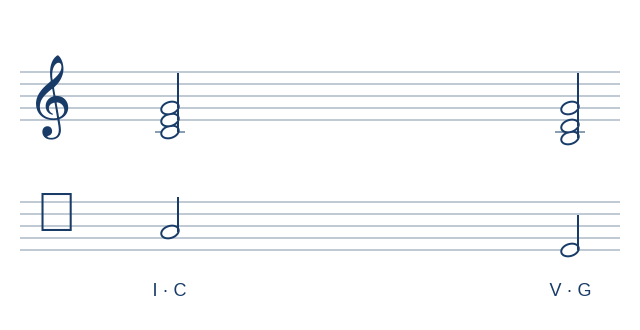
For now, we need two chords. Chord I (the tonic) feels like home. Chord V (the dominant) has a strong pull back towards home. In C major, chord I is C–E–G and chord V is G–B–D. Play those two chords slowly, then reverse them. The order matters.
Two chords in C major
Arriving home
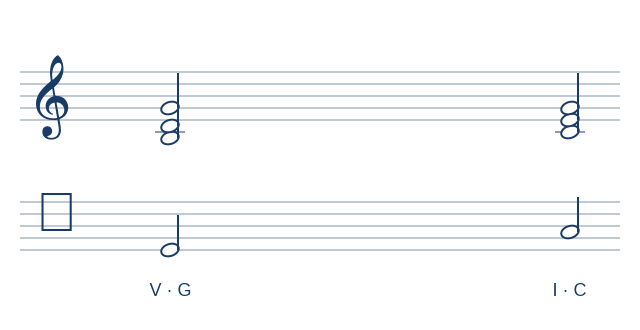
Leaving the thought open
Perfect cadence
G major → C major (V–I): a strong sense of arrival
Imperfect cadence
C major → G major (I–V): it feels as though another chord should follow
The two easiest cadences to hear
A perfect cadence is V–I. It often sounds settled and final, especially at the end of a phrase. An imperfect cadence ends on V, so it often sounds open, expectant or unfinished. It can be I–V, ii–V or IV–V: the defining point is that it lands on the dominant.
Try singing “do” over a C major chord, then “ti” over G major, then back to “do” over C major. You will feel the pull towards the tonic. That pull is doing much of the work.
One important warning: a cadence is not simply “the final two chords of any piece”. Listen for a phrase ending. Otherwise we might start declaring cadences every time somebody changes chord, which would make rehearsals rather long.
Have a go
Think through your answer, then open the explanation. These questions do not save a homework score.
1. In C major, what is chord I?
Show answer and explanation
C major (C–E–G): the tonic chord, I.
2. In C major, what is chord V?
Show answer and explanation
G major (G–B–D): the dominant chord, V.
3. Which cadence is V–I?
Show answer and explanation
Perfect cadence. It moves from dominant to tonic.
4. Which cadence ends on V and sounds as though it wants to continue?
Show answer and explanation
Imperfect cadence. It ends on V, leaving a sense of continuation.
5. You hear G major followed by C major at the end of a phrase. What cadence is likely?
Show answer and explanation
Perfect cadence, assuming the progression genuinely closes the phrase in C major.
Level 2 · I knew this once. Remind me
The four cadences you really need
Most GCSE and A Level listening questions expect you to recognise four common types: perfect, imperfect, plagal and interrupted. Rather than learning them as a disconnected list, listen for the destination chord and the strength of the arrival.
Cadences in C major
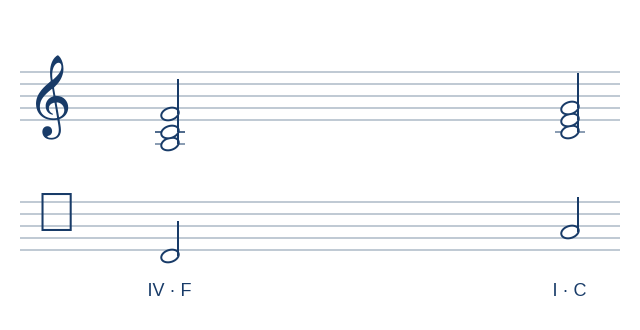
A different route home
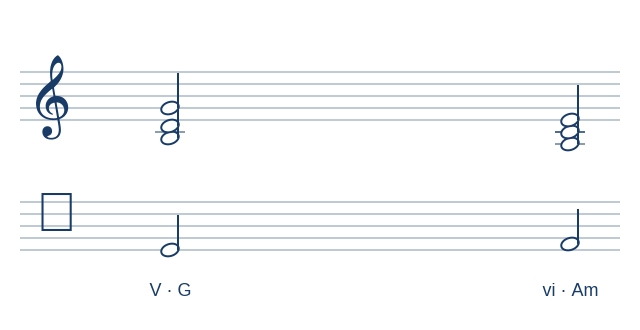
The expected ending takes a turn
Perfect cadence
V–I: G → C. Strong arrival on tonic.
Plagal cadence
IV–I: F → C. Also arrives on tonic, but with a gentler, different approach.
Imperfect cadence
Any chord → V: for example C → G or F → G. Open ending.
Interrupted cadence
V–vi: G → A minor. Expected tonic is replaced by a surprise.
How to hear the difference
Perfect versus plagal: both end on I, so hearing only the last chord will not help. Listen to the chord before it. The dominant V has a particular urge to resolve, often strengthened by the leading note moving up to the tonic. IV–I has a different bass movement and often feels more like a warm settling than a dramatic arrival.
Imperfect: listen for a phrase that stops on a chord which still wants to move. The dominant is the destination, not the starting point. It is the musical equivalent of saying “and then…” and wandering off to make a cup of tea.
Interrupted: V makes you expect I, but vi arrives instead. In C major, the expected C major chord is replaced by A minor. You still hear some smooth voice-leading, so the surprise can be quite subtle. It is not necessarily a loud, dramatic crash.
A practical listening method
First, find the phrase ending. Second, decide whether the final chord feels like home (I), the dominant (V), or an unexpected alternative (often vi). Third, listen backwards to identify the chord before it. Finally, check your answer against the musical context: does the phrase sound complete, suspended, gently settled or diverted?
If you have a keyboard, play the four progressions in the examples, all in C major. Keep the rhythm and register similar so you are really hearing the harmony rather than being distracted by different performances. Then ask someone to play them in random order.
Relative minor and a small complication
In a minor key, the dominant chord is often made major by raising the seventh degree. In A minor, that means E major (E–G♯–B) leading to A minor. E minor → A minor is not the same harmonic sound as a strong dominant-to-tonic cadence using E major → A minor.
Cadences in A minor
A major dominant in a minor key
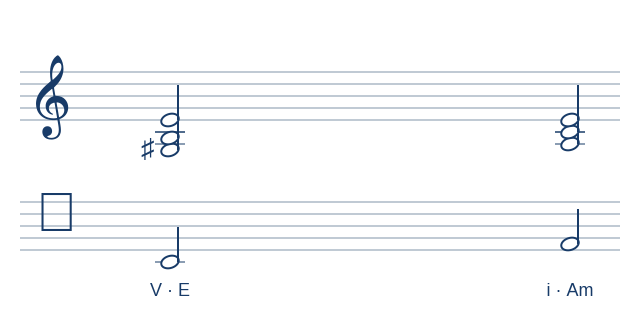
A minor-key surprise
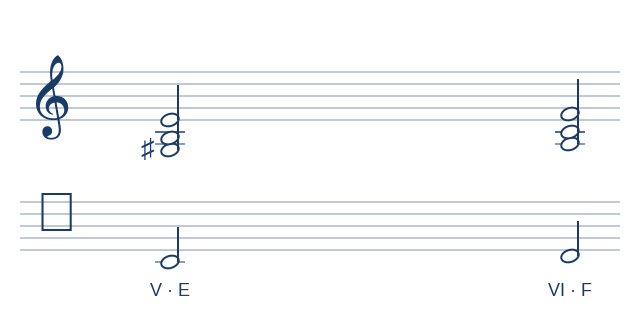
Perfect cadence
E major → A minor (V–i), with G♯ in the dominant
Interrupted cadence
E major → F major (V–VI), a common minor-key surprise
Plagal cadence
D minor → A minor (iv–i)
Have a go
Think through your answer, then open the explanation. These questions do not save a homework score.
6. Identify F major → C major at the end of a phrase in C major.
Show answer and explanation
Plagal cadence (IV–I).
7. Identify G major → A minor in C major.
Show answer and explanation
Interrupted cadence (V–vi).
8. Why is C major → G major an imperfect cadence?
Show answer and explanation
It ends on V, the dominant, rather than returning to the tonic.
9. Which two cadence types commonly end on the tonic chord?
Show answer and explanation
Perfect and plagal; both commonly end on I.
10. In A minor, which accidental helps make E major function as a strong dominant?
Show answer and explanation
G♯, the raised seventh degree of A minor.
Level 3 · Let’s get properly musical
The chords are only half the story
At A Level, it is worth being precise about how a cadence is voiced and how strongly it articulates a phrase. A root-position V–I with the tonic in the uppermost voice often produces a particularly decisive ending. An inverted tonic, an unusual soprano note or a continuation straight into the next phrase can weaken that feeling, even when the Roman numerals still read V–I.
A cadence is a harmonic event in a musical context, not a label you can attach by staring at two isolated chord symbols. Harmonic rhythm, metre, bass line, melodic resolution and phrase structure all affect what you hear.
Listen for the leading note and the bass
In C major, B is the leading note. In a strong V–I, B commonly rises to C. The bass often moves G → C, a perfect fourth upwards (or a perfect fifth downwards). That combination can make a perfect cadence especially clear. For IV–I, the bass typically moves F → C, a perfect fifth downwards (or fourth upwards), but the voice-leading does not contain the same dominant pull.
Cadential six-four: a particularly useful sound
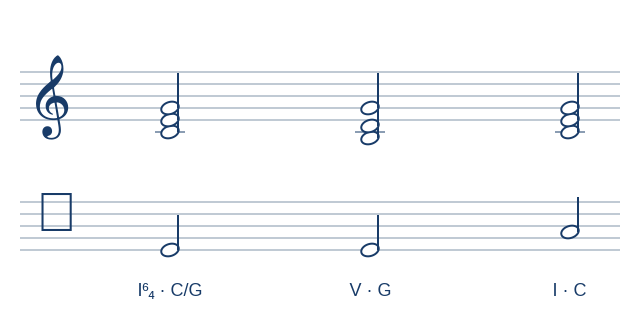
You may hear a tonic six-four sonority over the dominant bass, followed by V and then I. In C major, that can be C/G → G → C, often analysed as I⁶₄–V–I or, more functionally, a cadential 6/4 resolving onto V. The six-four sonority is not normally a free-standing tonic arrival here; it intensifies the dominant preparation. Listen for the notes above the dominant bass settling down before the final tonic.
Listen to the dominant preparation
Sevenths, suspensions and interrupted expectations
A dominant seventh adds another tension: G7 (G–B–D–F) → C. The F tends to resolve down to E, while B tends to rise to C. A 4–3 suspension over V delays the third of the dominant chord, creating a brief dissonance before resolution. These details can make a cadence more expressive without changing its underlying category.
Two notes with somewhere to go
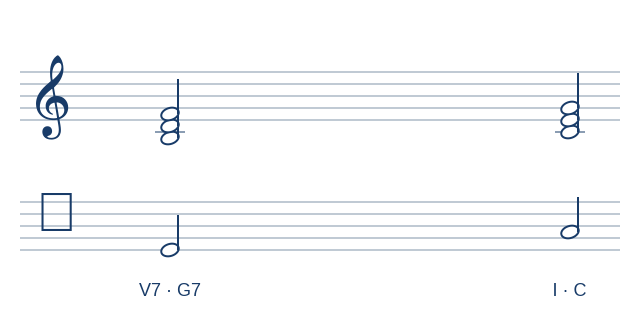
Interrupted cadences can be especially effective because V → vi (or V → VI in minor) avoids the expected tonic. The ear recognises the dominant preparation, but the harmony takes a different turn. That can prolong a phrase or set up a new section.
What about modulation?
A perfect cadence in a new key can help confirm a modulation, but one V–I progression alone is not always enough to prove that the music has changed key. Look for preparation, accidentals, a convincing new dominant and sustained emphasis on the new tonic. For example, D7 → G in music that began in C major may suggest a move towards G major, especially if F♯ becomes established and the new key continues.
A listening answer that actually says something
Rather than writing “there is a perfect cadence and it sounds finished”, try: “The phrase closes with a root-position dominant-to-tonic progression (V–I). The leading note resolves upwards to the tonic, while the bass moves from dominant to tonic, creating a strong sense of tonal closure.” Only include the details you can actually hear or verify in the score.
Have a go
Think through your answer, then open the explanation. These questions do not save a homework score.
11. In C major, G7 resolves to C. Name two common tendency-note resolutions.
Show answer and explanation
B → C (leading note to tonic) and F → E (seventh of G7 resolving down).
12. What is the purpose of a cadential six-four before V–I?
Show answer and explanation
It prolongs and intensifies dominant function, preparing the eventual V–I resolution.
13. A passage begins in C major and later uses D7 → G. Why might that suggest G major?
Show answer and explanation
D7 is V7 of G; its F♯ and resolution to G may help establish G as a new tonic if supported by surrounding music.
14. Why might a V–I progression not sound fully conclusive? Give two musical reasons.
Show answer and explanation
For example, an inverted final tonic, a non-tonic melody note, weak metrical placement, or immediate continuation can weaken closure.
15. In A minor, E major → F major ends a phrase. Identify the cadence and explain the expectation it avoids.
Show answer and explanation
Interrupted cadence (V–VI). E major suggests a resolution to A minor, but F major arrives instead.
Can you hear the ending?
Each phrase establishes C major before its final two chords. Listen first, choose a cadence, then check. You can listen again as often as you like.
Listening question 1
Listening question 2
Listening question 3
Listening question 4
Put your ears to work
Try Cadence Trainer: begin with perfect versus imperfect, then add plagal and interrupted cadences. For the chords themselves, use Chord Challenge. When you’re ready to hear a change of key, try Modulation Trainer.
Teacher tip: play each phrase twice. First ask whether it sounds finished, unfinished or surprising. Then ask students to name the cadence and explain where it ended. Use the ear training guide for a short practice routine, or refresh intervals by ear.